Color Link - Connect the Dots
Happy Games Co., Ltd.Casual
4.8785.00 Reviews
- Version
- 3.06
- Installs
- 5.00M
- Age Rating
- Everyone
Screenshots
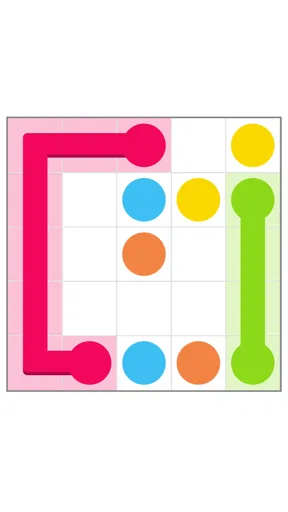
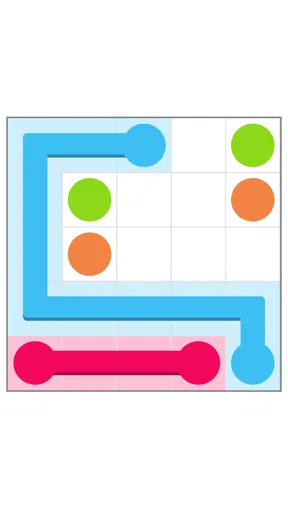
Our Review of Color Link - Connect the Dots
 Analysis by Appyee
I went into Color Link - Connect the Dots expecting a simple way to fill a few spare minutes, and that is exactly where this casual game works best. The basic idea is easy to understand: connect matching colors and clear the puzzle. There is no long tutorial to study and no complicated setup before the first move. I can open it, make a few links, and immediately understand whether I am in the mood for another round.
That simplicity is also the reason I would not recommend it to everyone. If you want a story, character development, competitive multiplayer, or a deep strategy system, this is not aimed at you. If you enjoy small visual puzzles that reward careful planning without demanding a large time commitment, it has a much stronger case. The loop is built around one satisfying action, a clear response, a small sense of progress, and the temptation to try again after resetting the board.
How the color-link loop feels in actual play
When I play a color-link puzzle, I get the most out of it by treating each path as a decision about the whole board, not just a quick match between two points. I scan for the pairs with the fewest possible routes, then connect those before using up the open space they need. That small change in approach makes each round feel more deliberate and sets up a closer look at how the game’s simple rules shape its challenge.
The first move is simple, but not mindless
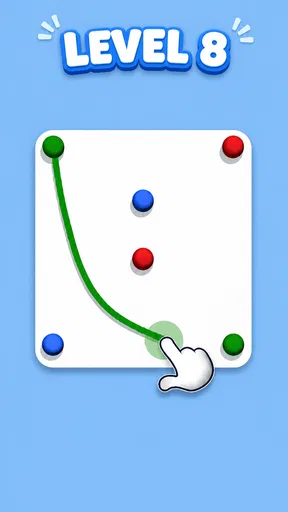
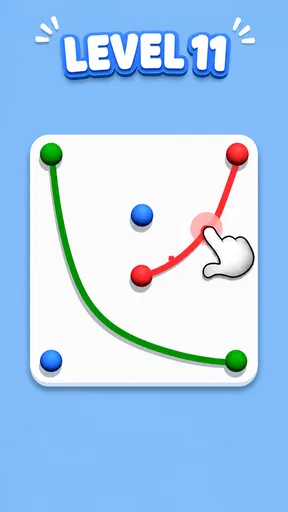
The opening interaction is the strongest part of the design. I look for two points of the same color, trace a connection between them, and watch the board respond. That first link gives the game its identity: the task is approachable enough for a quick start, yet the available space makes me consider where each line should go. A move that looks obvious at first can affect the room needed for the next connection.
This makes the game more interesting than simply tapping matching colors. The useful question is not only which pair belongs together, but also which route leaves the board in a workable state. I found myself scanning the whole puzzle before committing, especially when several colors were competing for the same open area. That habit is a practical tip for new players: connect the most restrictive pair first, rather than automatically choosing the closest-looking match.
The controls fit the concept because they keep attention on the puzzle instead of on menus. I do not need to learn a group of gestures or remember a complicated rule set. That makes Color Link suitable for a short break, a waiting room, or the final few minutes before bed. It also means the game has to earn my attention through the quality of its layouts and feedback, not through a large collection of systems.
For younger players, the Everyone content rating makes the premise feel approachable, while adults can still find a useful little mental exercise in arranging paths. I would describe it as a family-friendly puzzle rather than a purely educational game. It can encourage visual planning and patience, but it does not turn those skills into a formal lesson. The appeal comes from solving the immediate board, not from tracking a course or building a long-term skill tree.
Feedback turns each connection into a small reward
A good casual puzzle needs to tell me quickly whether an action helped, and the color-link format does that naturally. When a connection is correct, the visual result provides an immediate sense of order. A crowded board becomes easier to read, and the completed link gives me a reason to search for the next one. This is a modest reward, but it arrives at the right moment.
The rhythm is more important than any single puzzle. I make a connection, receive visual confirmation, reassess the remaining colors, and choose another route. That repeated cycle keeps the experience moving without requiring dramatic effects or a complicated reward economy. In my experience, the best sessions are the ones where I stop thinking about the interface and focus entirely on preserving space for the next path.
There is also a useful difference between a correct move and a merely possible move. A line may be valid on its own while still making later connections awkward. That creates the game’s main source of tension. I am not only looking for immediate approval; I am trying to avoid creating a dead end. This is where the title’s simplicity can be misleading. The rules are easy, but a clean solution can require restraint.
My advice is to pause after every completed link instead of dragging immediately toward the next visible pair. Check which colors remain and identify the pair with the fewest route options. This small pause reduces careless blocking and gives the game a more thoughtful pace. It is especially useful when I am playing quickly on a phone and my first instinct is to follow the most obvious color.
Why finishing a board feels rewarding
The reward in Color Link is mainly the completed arrangement itself. When the colors are connected and the board reaches a resolved state, the visual clutter gives way to a clear result. I like that the satisfaction comes from seeing the consequences of my choices rather than from a heavy progression system. The puzzle asks for attention, then gives me a tidy answer when I find the right structure.
That makes it a good companion for people who prefer self-contained challenges. I can finish a board and feel that the session had a clear ending, instead of stopping in the middle of a larger mission. It also makes the game easy to share informally with a child or a friend: the objective can be explained in a sentence, and the other person can start experimenting almost immediately.
At the same time, the reward may feel too light for players who need constant novelty. There is no reason to expect the same emotional payoff as a large adventure game or a competitive title. The pleasure is quieter: spotting a route, avoiding a blockage, and watching the final arrangement come together. I think that is a strength for short sessions, but a limitation if I want a game to occupy my full evening.
The store summary presents the experience as connecting dots, while the short description calls it Color Link. In practice, I would think of it as a visual path puzzle. That distinction matters because someone searching for a traditional dot-to-dot activity may expect a more passive sequence, whereas this game asks me to make decisions about placement and space. The appeal is in solving the layout, not simply following a numbered order.
Resetting the board creates the reason to play again
Once I complete a puzzle, the most important design decision is what happens emotionally next. Color Link works because the finished board does not demand a long ceremony. I can take the satisfaction of completion and then begin another challenge when I want. The reset is part of the loop: the solved layout disappears, a fresh arrangement asks for attention, and the same familiar action suddenly has a new problem to solve.
This is why the game fits short, repeatable sessions. I can play one board while waiting for an appointment, continue for several rounds during a quiet commute, or use it as a gentle break between more demanding tasks. The reset also prevents a single mistake from feeling permanent. If my planning becomes messy, I do not have to carry that failure into a lengthy campaign; I can simply learn from the blocked route and approach the next puzzle more carefully.
There is a trade-off here. A reset-based structure can feel refreshing when I want a clean mental slate, but it can also expose the limits of a minimalist puzzle game. Players who need a strong narrative reason to continue may find the next board less compelling than the previous one. The motivation is personal improvement and the pleasure of solving, not a dramatic plot twist or a changing cast of characters.
I also recommend treating the reset as a learning tool rather than rushing through it. If a board ends in an awkward position, remember the choice that caused the trouble: perhaps a central route was used too early, or a flexible color pair was connected before a constrained one. On the next attempt, reverse that order. This turns repeated rounds into a small experiment in planning instead of a sequence of random guesses.
Who will enjoy it, and who should choose something else
My strongest recommendation goes to casual players who like clear visual goals and compact challenges. It suits someone who wants a game that starts quickly, can be paused mentally at a natural stopping point, and does not require a large time investment. It is also a reasonable choice for families looking for a straightforward puzzle that can be understood without reading a long explanation.
People who enjoy organizing information visually may get more from it than players who prefer reflexes. The interesting decisions come from route selection, spacing, and order. I would choose this over a fast action game when I want to slow down without becoming completely passive. It gives my attention something specific to do, but the rules remain light enough that I do not feel as if I am studying.
I would skip it if my priority is a rich competitive ladder, social interaction, an unfolding story, or a deep collection system. I would also be cautious if I dislike repeating a familiar mechanic across many boards. Other casual puzzle games may be a better choice when I want wordplay, physics, time pressure, or a stronger sense of character progression. Color Link is at its best when the act of solving a clean visual arrangement is already enough motivation.
Another practical consideration is the free-to-play model. The game is free to download, but optional in-app purchases range from around three dollars to around twenty dollars per item. That does not change the basic appeal of trying it without an upfront purchase, but I would still approach any purchase carefully and decide whether it genuinely improves my experience. Someone who prefers a completely fixed-cost game may feel more comfortable with a paid puzzle that avoids this kind of store structure.
Everyday use: a small break that does not take over
One realistic use is a ten-minute pause between tasks. I might open the game after finishing a message, solve a board while my coffee cools, and stop after the next completed layout. Because the loop has a visible finish, I am less likely to feel trapped in an endless round than I would with a game built around continuous action. If I have more time, the reset gives me a natural invitation to continue.
It can also work as a low-pressure wind-down activity. The visual matching and path planning keep my mind occupied, but the lack of a frantic pace makes it easier to play casually. I would not call it a sleep aid, since screens and personal habits vary, but its structure is gentler than a game that constantly demands rapid reactions. The useful boundary is to stop after a solved board rather than automatically starting another one.
For parents, I would frame it as a shared puzzle rather than handing it over as a guaranteed learning tool. A child can try to find a route, while an adult can ask why one pair should be connected before another. That conversation brings out the planning element without pretending the game offers a formal teaching program. The Everyone rating supports its broad accessibility, but individual supervision and preferences still matter.
Performance expectations and practical setup
The game supports devices running Android eight or later, so it is available to people using a wide range of phones and tablets rather than only the newest hardware. Its current version is 3.06, and the project comes from Happy Games Co., Ltd. I appreciate that the basic premise does not ask me to learn a demanding control scheme before I can judge whether it belongs on my device.
Its popularity also gives it a useful signal for people who like established casual games: it has passed five million installs, with an average rating of 4.8 from around 122 thousand ratings. Those figures do not guarantee that every player will enjoy the same pacing, but they suggest that the accessible color-connection idea has found a broad audience. I would still use my own preferences as the deciding factor, especially if I know I need more variety than this loop provides.
The game was released on August 27, 2022, which places it in the category of a mature, already-established mobile title rather than a brand-new experiment. That is relevant when deciding whether to try it casually: I am not choosing it because of launch excitement, but because the core interaction remains easy to understand. The free entry point makes that decision simple, while the optional purchases are worth keeping in mind before allowing spending on a shared device.
What makes the loop work, and where it stops
The complete cycle is easy to describe. I choose a color pair, draw a link, receive immediate visual confirmation, and gain the satisfaction of making the board more orderly. When the puzzle is complete, the reward is the finished arrangement. Then the board resets, and a new layout gives me a reason to repeat the action. That is the entire engine, but it is coherent from beginning to end.
The strongest hidden quality is the way order of operations changes the experience. A beginner can connect whatever looks closest and still understand the rules. With a little practice, I start protecting open space, prioritizing constrained pairs, and treating every line as a decision about the rest of the board. That extra layer gives the simple concept more staying power than the short description alone suggests.
The main weakness is the same simplicity that makes it approachable. If I want a game to surprise me with new mechanics, a narrative, or a changing set of goals, this loop may become familiar quickly. The reset invites another session, but it cannot replace genuine variety for every player. I also think the purchase range deserves a careful look from anyone who prefers not to spend beyond the free experience.
Overall, I see Color Link as a focused casual game rather than an all-purpose mobile pastime. I would recommend it to a friend who enjoys visual organization, quiet problem-solving, and rounds that can begin and end without ceremony. I would not recommend it to someone seeking action or long-term progression. For the right player, though, the combination of one clear move, immediate feedback, a neat completion reward, and a fresh reset makes Color Link - Connect the Dots an easy game to return to when a small, satisfying puzzle is exactly what I want.
Verdict
Strengths of Color Link - Connect the Dots
- Simple connect-the-dots gameplay is easy to learn.
- Colorful visuals make the board pleasant to play.
- Short levels fit well into quick gaming sessions.
- Increasing difficulty keeps the puzzles engaging.
- Works well for casual players of different ages.
Limitations of Color Link - Connect the Dots
- Some puzzles may feel repetitive after extended play.
- Later levels can become frustrating without careful planning.
- Hints or extra help may be limited or costly.
- Ads may interrupt the experience between levels.
- The game offers little story or variety beyond puzzles.
Similar Picks in This Category
View All
My Talking Angela
Outfit7 Limited4.2

My Talking Tom
Outfit7 Limited4.3

Pou
Zakeh4.2

My Talking Tom 2: Pet Game
Outfit7 Limited4.3

Candy Crush Saga
King4.6

Bridge Race
Supersonic Studios LTD4.1
Frequently Asked Questions
What is Color Link - Connect the Dots?
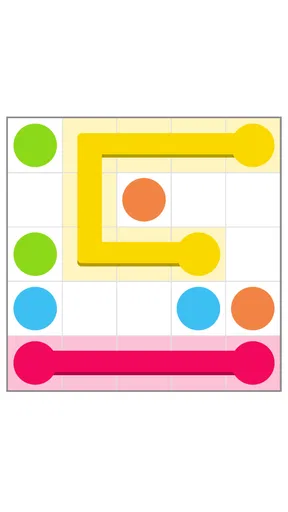
Color Link - Connect the Dots is a casual puzzle game based on linking matching colored dots on a grid. Your goal is to connect every pair without leaving any empty spaces, while making sure that lines do not cross. The game starts with simple layouts and gradually introduces larger grids and more challenging arrangements that require careful planning.
How do you play Color Link - Connect the Dots?
To play, select a colored dot and drag your finger across the grid until you reach the dot with the same color. You must connect all matching pairs and fill the entire board without overlapping another path. Some puzzles can be solved quickly, but more advanced levels require you to think several moves ahead and sometimes reconsider an earlier connection.
Is Color Link - Connect the Dots free to download and play?
Color Link - Connect the Dots can generally be downloaded for free, allowing players to access the core puzzle experience without an upfront purchase. However, depending on the version and platform, the game may include advertisements, optional hints, or in-app purchases. It is worth checking the store listing before downloading if you prefer an uninterrupted or completely ad-free experience.
Does the game require an internet connection?
Many of the standard puzzles in Color Link - Connect the Dots can usually be played offline once the game has been installed. This makes it suitable for short sessions while traveling or when mobile data is unavailable. An internet connection may still be needed for advertisements, analytics, updates, cloud features, or purchases, so offline availability can vary between versions and devices.
Is Color Link - Connect the Dots suitable for children?
The game is generally easy to understand and appropriate for players who enjoy visual logic puzzles, including many children. It does not rely on complex controls, violence, or fast reactions, although difficult levels may require patience and concentration. Parents should still review the app’s age rating, advertising practices, and possible in-app purchases before allowing younger children to play.
Play our best games!


